
7 Steps to Styling Contemporary Impressionist Art at Home
Last Updated: November 8, 2026
Quick Summary
Styling contemporary impressionist art at home starts with the wall, not the painting. Measure the space above your sofa, match one accent color from the artwork, and keep surrounding decor neutral so the painting remains the focal point. Hang the center roughly at eye level.
- Measure the wall first; a 30 x 30 inch canvas suits a large living room, while 24 x 30 inches suits a smaller one.
- Repeat one color from the painting twice elsewhere in the room, such as in a throw pillow and a vase.
- If the room has more than two strong colors plus the painting, remove one accessory.
- Hang the center of the artwork roughly at eye level, leaving a comfortable gap above the sofa.
- Keep pieces out of direct sunlight and away from bathroom steam to protect them over time.
Table of Contents
- Why Contemporary Impressionist Art Works in Modern Homes
- How to Choose Art for Living Room Walls
- How to Hang Art Above a Sofa, Scale and Placement
- Modern Impressionism Examples for Every Room
- Choosing Artwork for Home Decor on a Budget
- Start Your Impressionist Collection With a Piece You Can See in Your Home
- Frequently Asked Questions
Contemporary impressionist art can change a living room faster than almost any other decor. One painting with the right colors can make a room feel finished. Styling contemporary impressionist art at home comes down to a few clear choices, here are seven steps for any room.
Contemporary impressionism blends the loose brushwork of Impressionism with the color freedom of Post-Impressionism and Modern Abstract painting, so these pieces sit well in both traditional and modern homes.
Why Contemporary Impressionist Art Works in Modern Homes
Contemporary impressionist paintings use visible brushstrokes, bright color, and soft edges. Those qualities warm up hard lines in modern furniture and add movement to a plain wall, while landscape and garden subjects bring calm into busy rooms.
- Brushwork adds texture without extra decor
- Color can echo pillows, rugs, or throws
- Landscapes feel calm in small and large rooms
- Neutral frames let the paint do the work
How to Choose Art for Living Room Walls
Start with the wall, not the painting. For a longer walkthrough of picking living room art, see the detailed companion guide on living room art. Measure the space above your sofa or console, then decide how much visual weight the room can hold. A large living room can carry a 30 x 30 inch canvas easily, while a smaller room may suit a 24 x 30 inch piece.
Then ask three quick questions:
- What is the main color in the room?
- Does the room get strong natural light?
- Is the wall a focal point or a background?
Your answers point to the right painting. Warm rooms suit warm gold and orange tones; cool rooms with gray walls look best with blues, greens, and soft pinks.
Matching Artwork Colors to Your Existing Accents
Pick one color from the painting and repeat it twice elsewhere in the room. A blue sky in a landscape can return in a throw pillow and a vase. This creates a loop that makes the art look planned.
Matching one accent often works better than matching the whole palette, too many matches make a room feel busy.
Balancing Vivid Paintings With Colorful Decor
A bold painting needs calm around it. If your rug is patterned and your curtains are bright, let the painting be the single loud element. Keep walls and large furniture neutral, such as white, beige, or soft gray.
Quick check: if the room has more than two strong colors plus the painting, remove one accessory.
How to Hang Art Above a Sofa, Scale and Placement
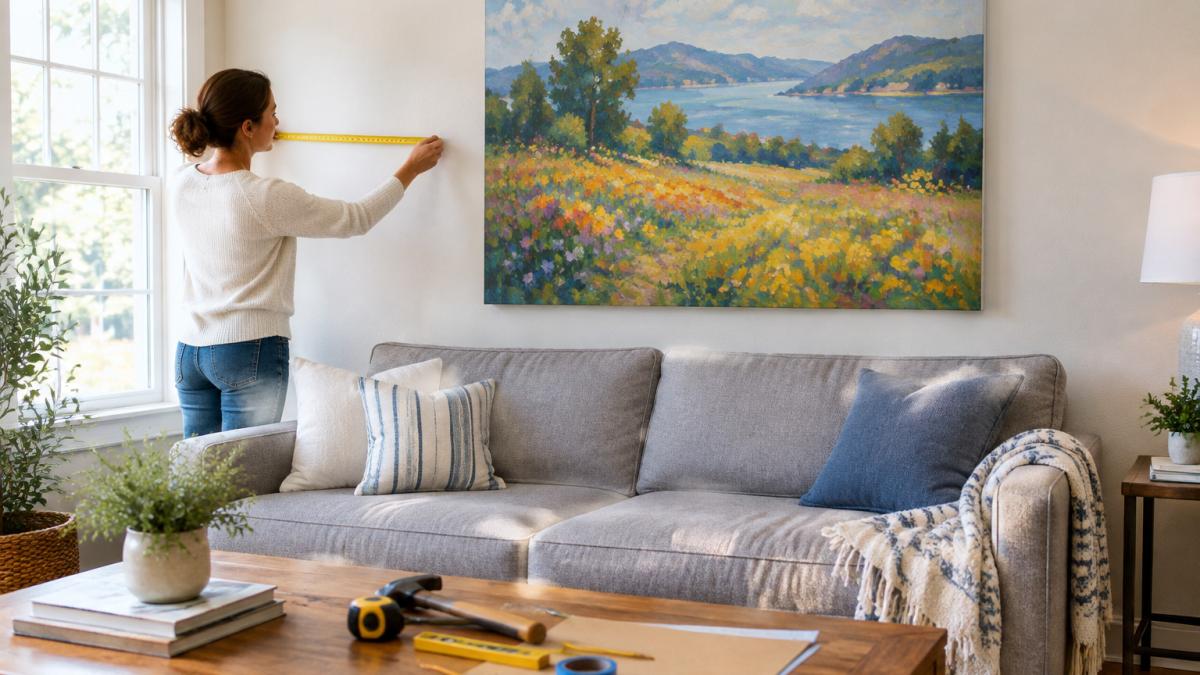
Hang the center of the artwork roughly at eye level, leaving a comfortable gap between the top of the sofa and the bottom of the frame. Heavier canvases need proper support, so see how to hang heavy paintings safely without damaging walls. A painting that is too small can look lost, so consider a piece sized in proportion to the sofa.
Modern Impressionism Examples for Every Room
Each room asks something different from a painting. The plans below give you a starting point for scale, palette, and placement in the four rooms where contemporary impressionist work does the most work.
Living Room: One Large Focal Piece
The living room is where contemporary impressionism earns its keep. A single large canvas over the sofa anchors the seating group and gives the eye a place to rest. Consider a piece roughly two-thirds the width of the sofa.
Choose a landscape or garden subject with a clear horizon. Horizons read well from across the room and reinforce the horizontal line of the sofa. A piece like the Brenda's View at Lorenzi Estate 24 x 30 Embellished Giclee Print at $1,155.00 works as a solo focal point on a narrower wall or as the center of a three-piece grouping on a wide one. You can also see a framed original oil landscape in a room setting.

Watch out: a canvas spanning less than half the sofa width looks like a postage stamp and makes the room feel unfinished.
Bedroom: Soft Palette, Lower Contrast
Bedrooms reward restraint. Contemporary impressionist work with soft blues, greens, and muted pinks keeps the room restful, while high-contrast or heavily saturated pieces can feel agitated in a space meant for winding down.
Dining Room: Warm Subjects, Centered Composition
Dining rooms carry floral and table subjects especially well, and warm golds, oranges, and reds stimulate appetite and conversation. Center the piece on the wall behind the head of the table, or on the longest uninterrupted wall if the table is round.
Keep the frame simple here. A dining room already has visual activity from chairs, glassware, and a chandelier, so a thin neutral frame lets the paint carry the room.
Entryway: Small Scale, Bright Welcome
Entryways are transitional spaces, so the art should read quickly. A smaller piece in a bright palette greets guests without crowding a narrow wall.
What Makes Contemporary Impressionism Different
Contemporary impressionism differs in three ways that change how you style it. First, the scale is often larger and more varied, because living artists paint for modern wall sizes. Second, the palette tends to be more saturated and less tied to naturalistic light, so it holds its own against modern furniture colors. Third, the subject matter often leans toward abstraction at the edges, so the piece reads as contemporary art rather than a period reproduction.
That distinction matters when you mix eras. A historical impressionist print pairs best with traditional furniture and warm wood tones. A contemporary impressionist canvas sits comfortably above a modern sectional, a mid-century credenza, or an antique buffet, because its color and brushwork bridge the two.
For a lighter touch in a window, the Colorful Impressionist Tree 84 x 50 inch Sheer Window Curtain at $75.00 brings the same painted feel to a room without a wall piece.
Choosing Artwork for Home Decor on a Budget
Budget decisions matter as much as style, and the biggest mistake buyers make is comparing sticker prices without accounting for framing, glazing, and long-term care. The three purchase paths below differ in cost, appearance, and protection needs.
Originals, Reproductions, and Prints Compared
An original painting is a one-of-a-kind work by the artist.
An embellished giclee print is a high-resolution reproduction lightly embellished with texture. A piece like the Brenda's View at Lorenzi Estate 24 x 30 Embellished Giclee Print at $1,155.00 sits in this category.
Framing and Glazing Costs to Plan For
Framing is where budgets quietly blow up. Framing and glazing can add meaningful cost to a piece, so factor them into your total budget.
Watch out: hanging any print or painting in direct sunlight, even behind UV glazing, will fade it over time, move the piece to a wall that receives indirect light.
Protecting Your Piece: Light, Humidity, and Cleaning
Ultraviolet light can fade artwork over time, so keep pieces out of direct sun where possible.
Humidity matters too. Bathrooms and kitchens are poor locations for original works and paper prints because steam and grease settle on the surface. If you want art in a bathroom, choose a sealed canvas print and keep it away from the shower.
Sourcing With Confidence
Roxy Rich Fine Art ships to the continental USA, and prints from the Print Shop come with a 30-day money-back guarantee. Check whether a piece ships framed or unframed before you buy, and factor framing and glazing into your total budget rather than treating them as an afterthought.
The article compares the three main purchase paths, so here is a quick summary of how they differ.
| Option | Best for | Key difference |
|---|---|---|
| Original painting | One-of-a-kind collectors | Unique work by the artist |
| Embellished giclee print | Lower cost, textured look | High-resolution reproduction with light embellishment |
| Sealed canvas print | Humid rooms like bathrooms | Keep away from shower steam |
Start Your Impressionist Collection With a Piece You Can See in Your Home
A collection starts with one piece you love. Choose a painting that matches your main room color and fits your wall, then add one accent over time, a print for the hallway or a window curtain for the dining room.
Browse the full range at Roxy Rich Fine Art to find the piece that fits your space, and start styling contemporary impressionist art at home today.
Frequently Asked Questions
How do you decorate a room with impressionist art?
Start with one large impressionist piece as the focal point, then pull one or two of its colors into pillows, a rug or a vase so the room feels connected. Keep the surrounding furniture neutral in white, gray or beige so the painting carries the color. Natural light shows impressionist brushwork best, so hang the piece where daylight falls across it during the hours you spend in the room. Avoid crowding the wall with many competing pieces, since impressionist work needs space to read well.
How high should you hang a painting above a sofa?
A common guideline is to leave a comfortable gap between the top of the sofa back and the bottom edge of the frame. This keeps the artwork connected to the furniture without feeling crowded. Measure your sofa width, mark the wall with painter's tape and step back to check the placement before drilling.
Should artwork match the colors in a room?
Artwork does not need to match the room exactly, but it should share at least one or two colors with your existing accents. Pull a blue or warm yellow from the painting into a pillow or throw so the eye moves between them. If the room already has bold colors, choose a painting with softer tones to avoid visual competition.
