
7 Steps to Choose Art for Your Living Room
Last Updated: November 1, 2026
Quick Summary
Choose living room art by starting with the room, not the artwork: photograph your walls in daylight, note sofa and console widths, and list your three dominant colors. Size living room art at roughly two-thirds to three-quarters the width of the furniture below it, and hang it so the center sits 57 to 60 inches from the floor.
- Find your focal wall first and give it the statement piece; everything else supports it.
- Pull one color from your existing palette, then add one new color you're happy to see daily.
- A 72-inch sofa wants art around 48 to 54 inches wide, or a group totaling that width.
- Keep gaps between gallery wall frames consistent, around 2 to 3 inches.
- Above a sofa, set the bottom of the frame 6 to 10 inches above the sofa back.
Table of Contents
- Start With the Room, Not the Art
- How to Match Art With Living Room Decor
- Living Room Art Size Guide: Getting Scale Right
- Living Room Gallery Wall Layout That Works
- Hang It Right: Height, Hardware, and Protection
- Shop Original Living Room Art From Roxy Rich Fine Art
- Frequently Asked Questions
Start With the Room, Not the Art
Most people shop for art backwards: they fall for a painting online, bring it home, and discover it fights the sofa, floats too high, or disappears against the wall.
Living room art works best when it responds to what's already there: the sofa, rug, wall color, and light. Art that ignores these looks pasted on; art that answers them looks built in.
Before you browse a single painting, do three things:
- Photograph every wall in daylight
- Note your sofa and console widths
- List your room's three dominant colors
Identify Your Focal Point
Every living room has one wall that pulls the eye. Find yours first.
It's usually the wall you face when you sit down, or the one behind the largest piece of furniture, a fireplace, big window, or sofa wall.
If your room has no obvious focal point, create one. A large framed painting above the sofa does the job instantly.
Take Stock of Your Color Palette and Decor Style
Write down the colors you already live with. Be honest, not aspirational.
Pull from the rug, curtains, largest upholstered piece, and wall paint. You'll usually find two neutrals and one accent, that accent is your bridge color and the fastest way to make new art feel intentional.
Then name your style in plain words: traditional, modern, coastal, rustic, eclectic. If you can't name it, photograph the room, patterns and finishes reveal the answer fast.
How to Match Art With Living Room Decor
Matching art to decor comes down to two moves: echo what's there, then add one deliberate contrast. Art that only echoes feels flat. Art that only contrasts feels random.
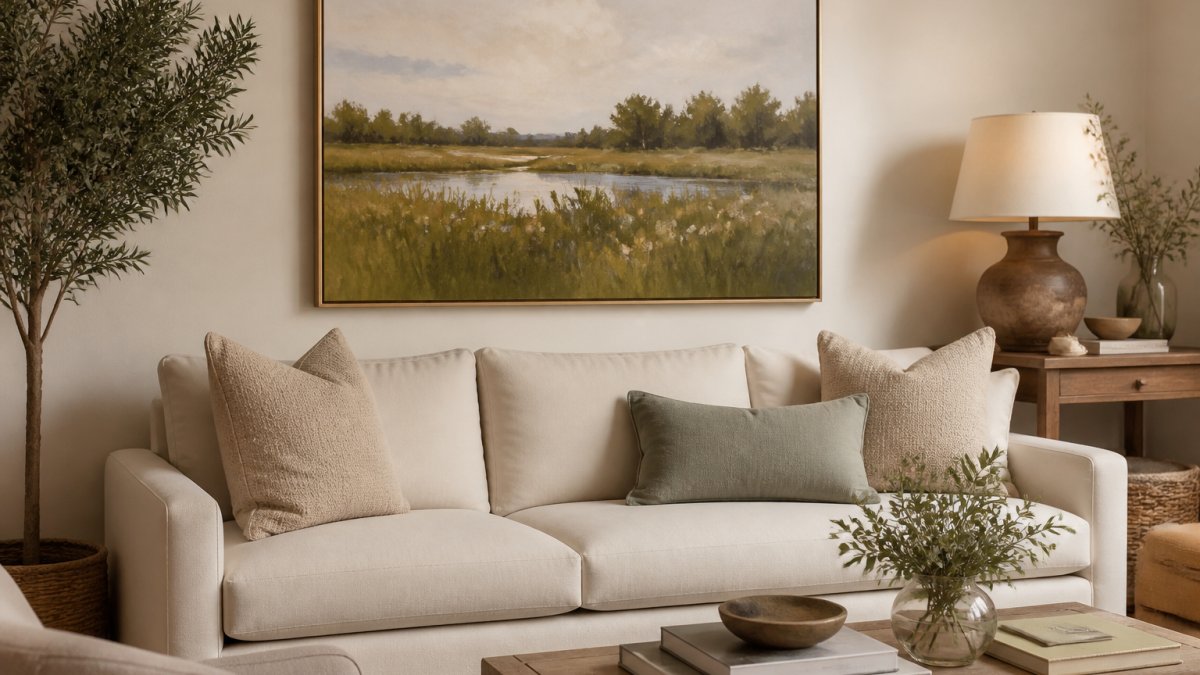
Start with the echo. A palette knife landscape brings that warmth plus visible texture.
A common mistake is buying art that matches the sofa exactly. It vanishes. You want the piece to relate to the room, not disappear into it.
Pull Hues From the Room, Then Add Contrast
Pick one color from your existing palette and let the artwork repeat it. Then let the artwork introduce one new color you're happy to see every day.
That new color can live in a pillow, throw, or vase. A fine-art lumbar pillow shows how to pull hues and motifs from artwork into living room textiles for a cohesive look.
Watch out: don't pull more than two colors from the art into your textiles. Past that, the room starts to look themed rather than collected.
Living Room Art Size Guide: Getting Scale Right
The right size for living room art is roughly two-thirds to three-quarters the width of the furniture below it.
This is the step people get wrong most often: too small leaves the wall unfinished, too large crowds the room.
Use this quick reference:
| Furniture Width | Art Width (Single Piece) | Gallery Wall Total Width |
|---|---|---|
| 60 in. sofa | 40-45 in. | 40-45 in. |
| 72 in. sofa | 48-54 in. | 48-54 in. |
| 84 in. sofa | 56-63 in. | 56-63 in. |
| 48 in. console | 32-36 in. | 32-36 in. |
Measure the wall too.
For a single dramatic piece, size up: a bold painting above a sofa does more than three small prints ever will.
Willow in the Park Original Oil Landscape Painting Framed →
Living Room Gallery Wall Layout That Works
A gallery wall layout works when it has one anchor and a clear outer edge.
Plan on the floor first. Paper templates taped to the wall take fifteen minutes and save a dozen nail holes; a laser level or chalk line keeps edges honest once you commit.
Three layouts that hold up in real rooms:
- Grid: matched frames in even rows. Calm, formal, best for modern rooms. Keep row and column gaps identical so the grid reads as a grid.
- Salon: mixed sizes clustered tight. Traditional, collected, best over a console. Work from the center out and keep the outer edge roughly rectangular.
- Linear: one row of same-height pieces. Clean and simple, best in narrow spaces. Align the centers, not the tops, if frame heights differ.
Keep gaps between frames consistent, around 2 to 3 inches. Mixed frames can work if mat widths stay similar so the group reads as one unit.
Spacing Math That Keeps a Gallery Wall From Drifting
Treat the whole group as one object and size it like a single piece: total width about two-thirds to three-quarters the width of the furniture below it. A 72-inch sofa wants a gallery wall roughly 48 to 54 inches wide overall, gaps included.
Center the group on the furniture, not the wall, unless the furniture is off-center, then split the difference so the art feels tied to the seating area.
Set the vertical anchor first: center the group at eye level, typically 57 to 60 inches from the floor, or set the bottom row 6 to 10 inches above the sofa back. Build every other frame off that line, or the group creeps upward frame by frame.
Hanging a Gallery Wall on Different Wall Types
Leave at least 6 inches of breathing room between the group's outer edge and any adjacent wall, window, or tall furniture. A gallery wall that runs into a corner or curtain reads as crowded no matter how good the pieces are.
Hang It Right: Height, Hardware, and Protection
Hang art so the center sits at eye level, typically 57 to 60 inches from the floor. Above a sofa, aim for the bottom of the frame 6 to 10 inches above the sofa back. Those two numbers are a useful starting point.
Hardware and Wall Type
- Drywall: use two hooks spaced a few inches apart, not one. The piece stays level and holds more weight. Drywall anchors for anything over a few pounds; toggle bolts for heavier frames in hollow wall.
- Plaster: drill pilot holes to avoid cracking, use anchors rated for the load, and avoid over-tightening.
- Brick or stone: masonry anchors or sleeve anchors. Adhesive strips are not reliable on textured masonry.
Lighting, Glare, and Color Perception
Light does two jobs at once: it lets you see the art, and it can quietly damage it. Direct sun fades pigments over time, and ultraviolet light does the most damage. Keep pieces off the brightest wall, or add UV-filtering glazing if the wall is the only option.
Glare is the other problem. Angle lights about 30 degrees from the wall so reflections fall away from the viewer. A picture light above the frame works for a single piece; for a gallery wall, aim for even wash rather than a hot spot.
Color perception matters too: warm bulbs push a painting warmer, cool bulbs cooler. A warm painting under warm room light can look muddy, so check the piece under the room's actual light before committing.
Protection Habits
- Keep art away from heat vents, radiators, and humid rooms on shared walls.
- Avoid hanging directly above a fireplace if the mantel gets hot; heat and soot are hard on paint and glazing.
- Dust frames with a soft dry cloth rather than spraying cleaner onto the surface.
The Smithsonian's guidance on caring for paintings is a useful reference on caring for paintings.
Shop Original Living Room Art From Roxy Rich Fine Art
Choosing art gets easier once you know what you're looking for.
Originals from Roxy Rich Fine Art ship with shipping included to the continental USA, and the paintings listed in our catalog arrive framed and ready to hang.
A few pieces that suit a living room wall:
- A framed original oil painting of a fluffy rust-colored bird
- A framed mountain landscape in palette knife oil
- A colorful framed watercolor of fish
If you're unsure about scale or color, measure your wall, photograph it in daylight, and compare the piece's listed dimensions against your sofa width.
Frequently Asked Questions
What size art should I choose for my living room?
A common rule is to size wall art to about two-thirds to three-quarters of the width of the furniture below it. Above a standard 84-inch sofa, that means a piece roughly 56 to 63 inches wide, or a grouping that totals that width. For a large empty wall, a single large-scale canvas or a tight cluster of smaller framed pieces fills the space better than one small print floating in the middle. Measure your wall space and furniture before you shop.
How do I match wall art to my living room colors?
Start with the colors already in the room, then decide whether you want the art to blend or stand out. Pulling one or two hues from your rug, pillows, or upholstery creates a cohesive look, while a bold piece with a contrasting palette becomes the focal point. Bring fabric swatches or paint chips when you shop, and check the art against them in daylight. The Willow in the Park original oil landscape comes in a rich, deep brown mahogany-stained wooden frame.
How high should artwork hang above a sofa?
The center of the artwork should sit about 57 to 60 inches from the floor, which is roughly eye level for most adults. Above a sofa, leave 6 to 10 inches of breathing room between the top of the sofa back and the bottom of the frame. If you are hanging a gallery wall, treat the whole arrangement as one unit and center it on that same line. Always measure and mark before drilling.
Should living room art match the furniture?
It does not need to match exactly, but it should feel related. Coordinating frames and finishes with your furniture, such as a dark wood frame near dark wood tables, ties the room together. The subject and mood can differ from the furniture style to add visual interest and give the room a conversation starter. A contemporary impressionist painting can sit happily in a traditional room when the frame and colors connect to what is already there.
Picking living room art is really a series of small, confident decisions: measure the wall, name your colors, choose a focal point, and buy the piece that answers all three. Roxy Rich Fine Art makes that last step simple, with original paintings shipped free to the continental USA, framed and ready to hang, and a 30-day money-back guarantee on print shop purchases. Browse the collection, find the piece that fits your wall, and add it to your cart.
